
Marine Ecology
Life in an estuary changes around the clock.
Eelgrass meadows and oyster farms support fish and invertebrates, but their use of these habitats changes with daylight and the tides. Research led by Austin Williams in Oregon’s Tillamook Bay explores these patterns to better understand the ecological role of shellfish aquaculture.
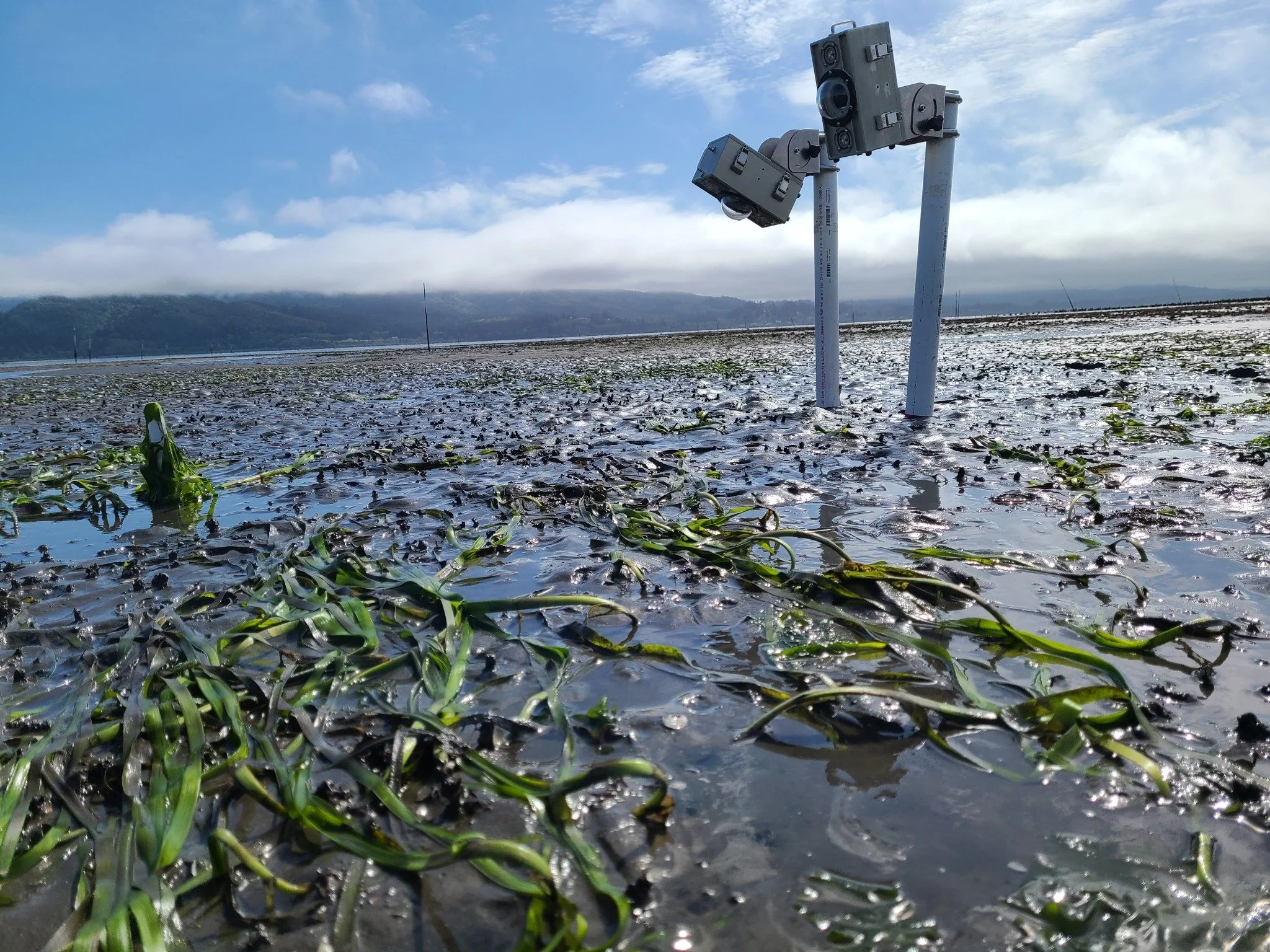
The research
Completed for Austin’s master’s thesis at Oregon State University, the study used underwater cameras to observe fish and mobile invertebrates, collectively called nekton, across seven combinations of eelgrass density and oyster-culture habitat. Cameras recorded through daylight and darkness over several days, while complementary seine-net surveys provided another view of the animals using these areas.
The video analysis recorded 2,401 observations across 21 taxonomic groups. Fish and invertebrate communities differed significantly between day and night, and several species showed stronger habitat associations during daylight. Smelt were observed predominantly at night, while species such as shiner perch and Pacific staghorn sculpin showed daytime habitat preferences that became less distinct after dark.
These findings suggest that oyster-culture structures can provide habitat for some estuarine species, with their role depending on the surrounding eelgrass and the time of observation. They also show why daytime surveys alone can miss important patterns of habitat use.
Continuing the work
Austin is continuing this research with the USDA Agricultural Research Service and collaborators Brett Dumbauld, Joseph Brockman, Mena Moran, and Brooke McIntyre. The next phase incorporates an additional summer season, updates the analyses, and develops a manuscript for peer-reviewed publication.
The expanded study will examine whether day–night patterns persist across seasons, how individual species use different habitats, and how those relationships change with ebb and flood tides. Comparisons between camera observations and seine catches will also help evaluate what each sampling method reveals.
Why it matters
Understanding when animals use a habitat is essential to understanding its ecological value. This research can inform monitoring, eelgrass conservation, and shellfish-aquaculture management by considering habitat use across daily, tidal, and seasonal cycles.
A new window into estuary life
The study used custom ROONEY cameras (Remote Observation of Oysters, Nekton & Eelgrass ecologY) designed and built in collaboration with the Sexton Corporation for the intertidal environment. Each system combined a protected action camera, programmable controls, battery power, and LED lighting. Synchronized recording and lighting allowed researchers to observe multiple habitats under comparable conditions, including after dark. In this study, the cameras recorded two-minute clips every ten minutes over a 75-hour deployment.
The innovation is the ability to return repeatedly to the same habitats and observe animals through changing light and tides, without needing a field crew present for every sample or capturing the animals. Repeated deployments could build a consistent visual record across seasons and years, helping managers track changes in habitat use, evaluate restoration, and monitor aquaculture sites. Archived footage can also be reviewed again as new questions arise.
Long-term monitoring would still require maintenance, consistent camera placement, and careful interpretation: water clarity, vegetation, and nighttime lighting can affect which animals are detected and how they behave. The cameras complement other survey methods while revealing patterns that daytime field visits can miss.
Different communities by day and night
Each triangle represents the fish and invertebrate community observed in a habitat sample. Yellow upward triangles show daytime observations; blue downward triangles show nighttime observations.
Points closer together have more similar communities. Their separation shows how community composition changed between day and night, highlighting what daytime surveys can miss.
Original NMDS graph from Austin Williams’s thesis defense, slide 20. Click the graph to enlarge.
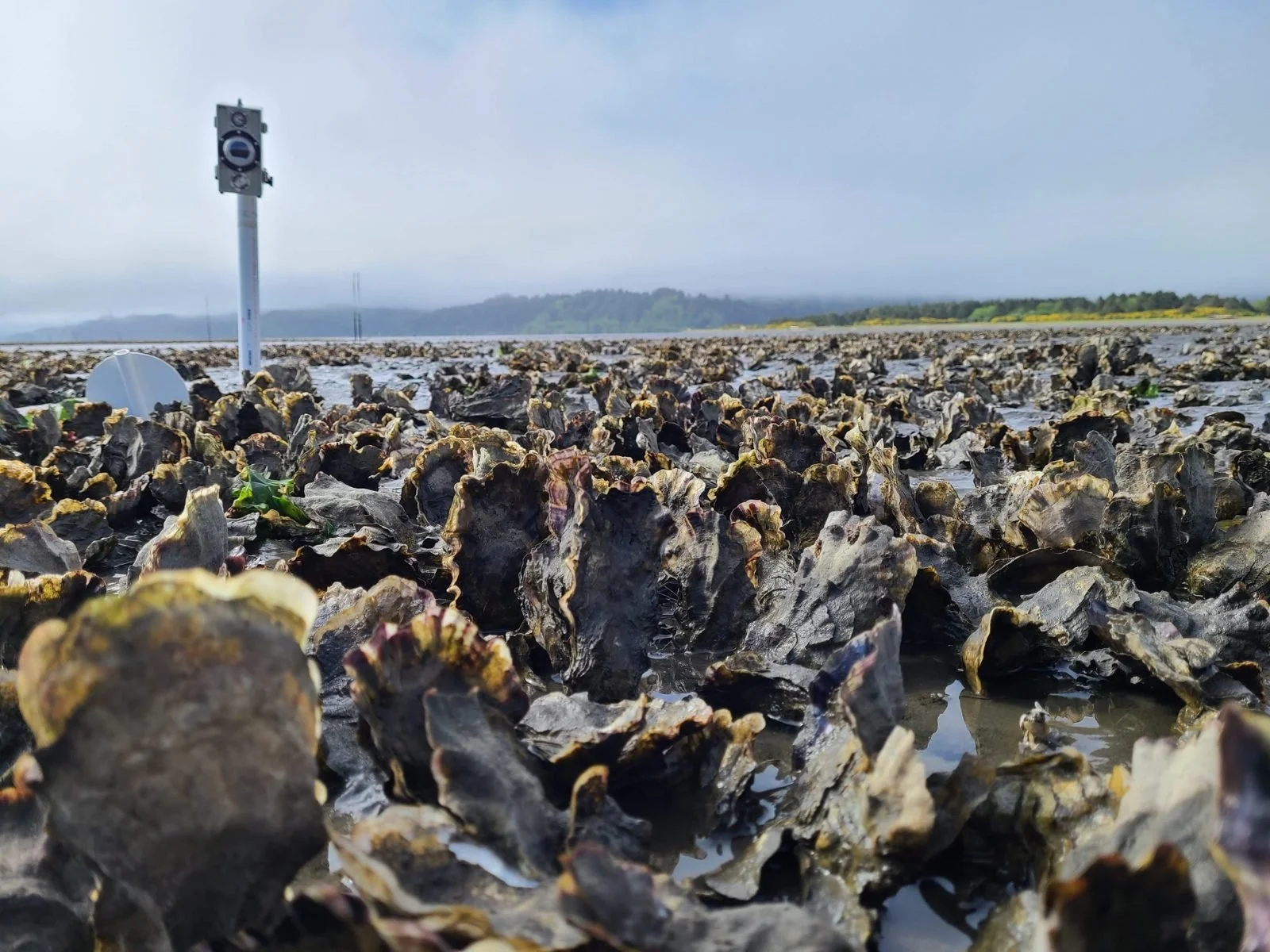
A research camera overlooks an oyster bed exposed at low tide in Tillamook Bay.
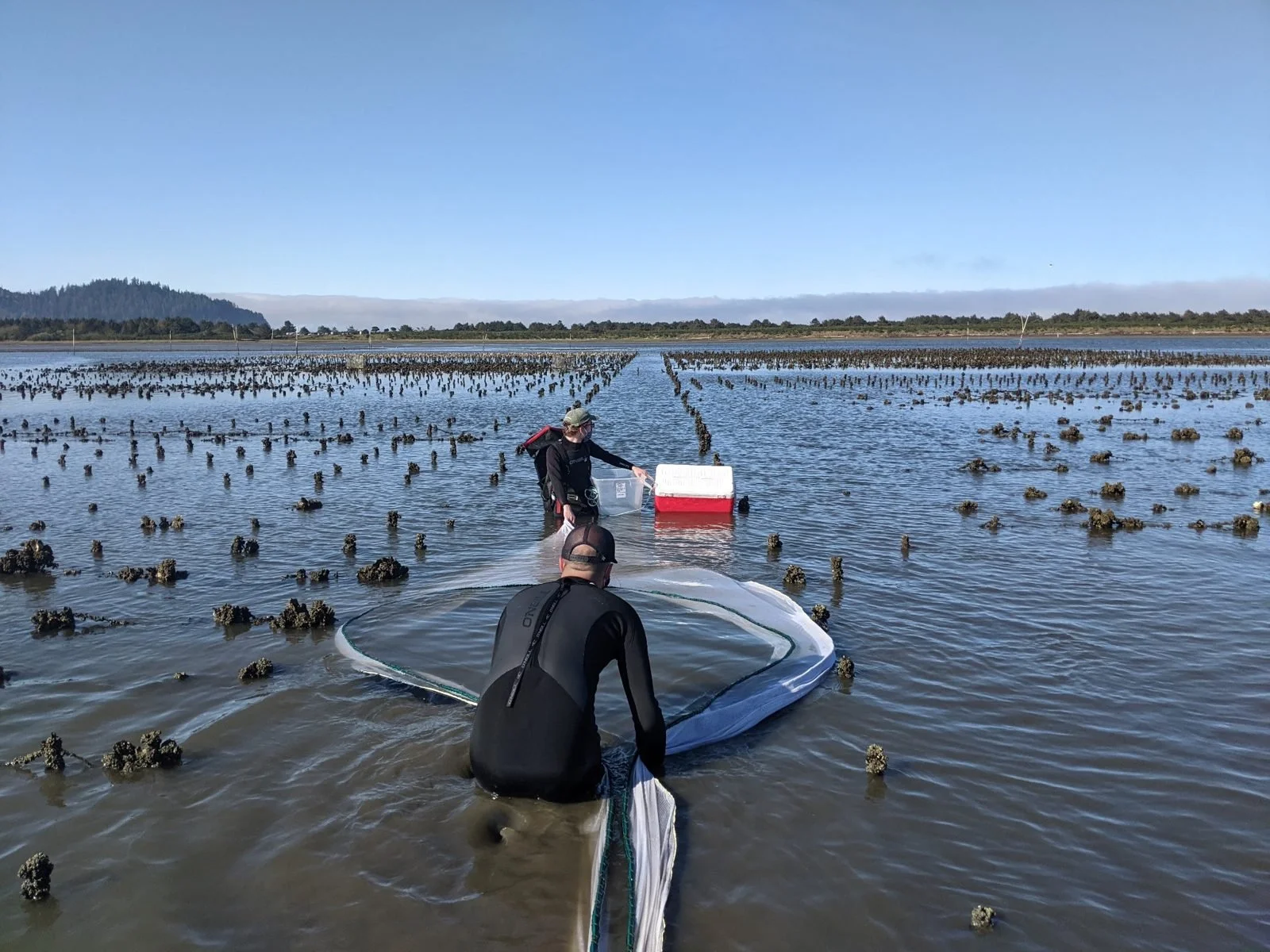
Researchers use a seine net to sample fish and invertebrates among oyster-culture structures.